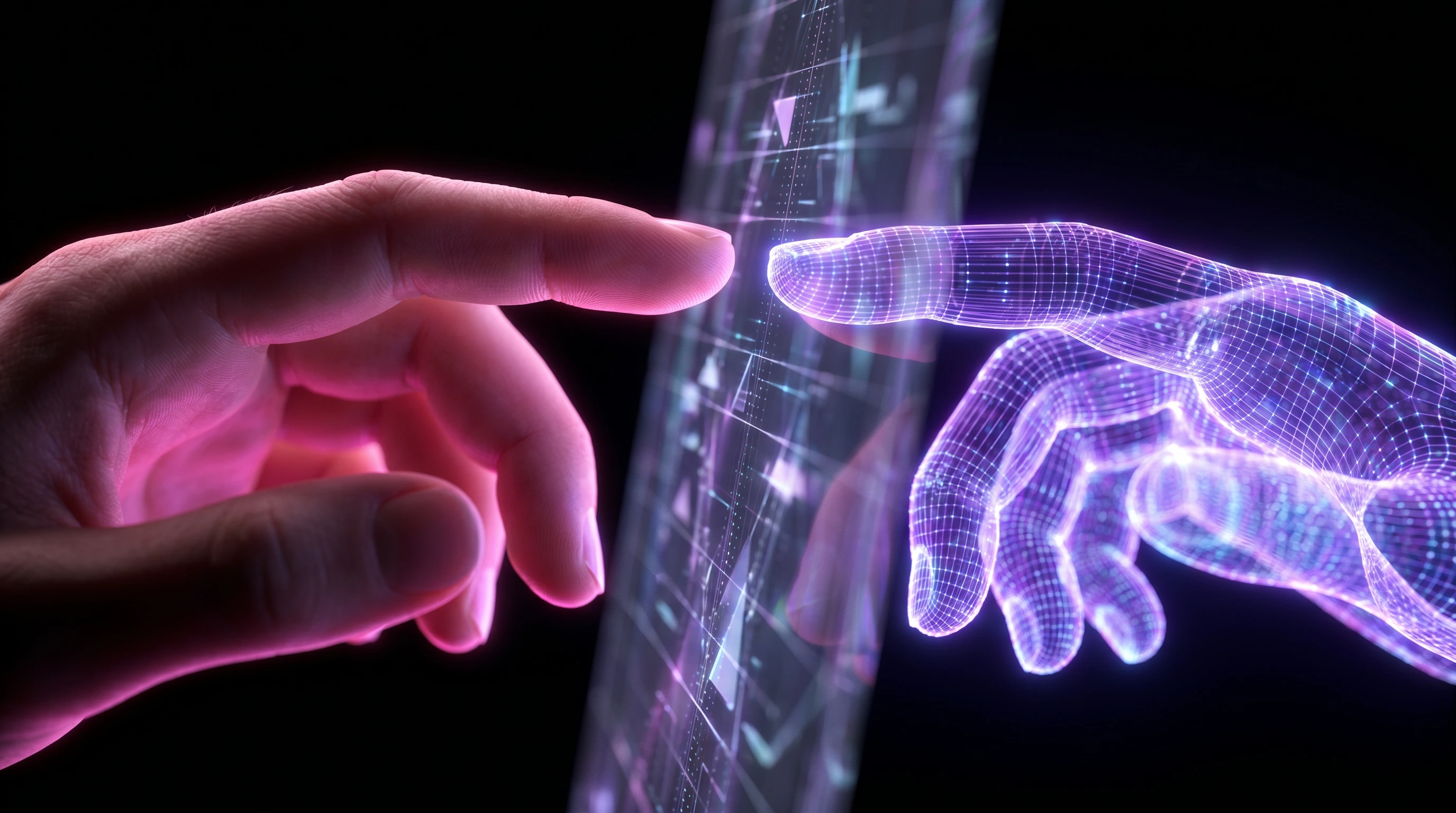
Touch is the first language we learn.
Before words, before eye contact, before the recognition of faces — there is touch. A hand against skin. Warmth. Pressure. The simple, wordless fact of another person's presence communicated through contact.
For most of human history, touch required proximity. To feel someone, you had to be near them. Distance meant absence — not just physical absence, but a specific kind of sensory void that no letter, no phone call, no video screen has ever fully closed.
That's what we set out to change.
Phantom Hands is Kamaverse's real-time haptic connection feature. When one partner touches their phone screen, their partner's device responds — not with a notification, not with a generic buzz, but with a gesture. A touch that mirrors the original. A presence transmitted across however many kilometres happen to separate you.
It's called Phantom Hands because that's exactly what it is: the sensation of a hand that isn't physically there, but feels like it is.
We kept hearing the same thing from couples, from different angles.
Long-distance partners described this: everything works — video calls, messages, synced shows — but something is still missing. When asked to name it, the answer was almost always the same. Touch.
Couples sharing the same home described a different version: the creeping distance that develops not from kilometres but from busyness. The weeks where you share a space but barely share a moment.
Touch turns out to be load-bearing in both scenarios. We needed to find a way to let people feel each other — not simulate feeling, not gesture toward it, but actually create a haptic channel between two devices that becomes a proxy for physical closeness.
Open Kamaverse. Open Phantom Hands. When your partner does the same, a connection is established. Touch your screen — slowly, quickly, a pattern, a rhythm — and they feel it. A calibrated haptic response that mirrors what you did, when you did it.
It works across any distance with an internet connection. The latency is low enough that the experience feels synchronous. Partners on opposite sides of the world have described it as feeling like holding hands.
Phantom Hands was designed primarily for long-distance couples, but we've found it used in ways we didn't fully anticipate.
Partners in the same city who can't see each other that week. People who process love kinesthetically — who feel most connected through physical sensation rather than words. Couples who want a moment of connection during a long workday without the overhead of a call.
Touch doesn't require an occasion. That's part of what makes it irreplaceable.
Phantom Hands is the first haptic feature we've shipped, but it isn't the last. We're working on new interaction patterns, shared rhythm modes, and eventually, hardware that extends what's possible well beyond a phone screen.
If you haven't tried it yet, open Kamaverse and find someone to connect with. It takes about thirty seconds to set up and considerably longer to forget.
Distance is a condition. Connection is a practice. We built Phantom Hands to make that practice a little more physical — no matter where you both happen to be.

A private universe built for two.
© 2026 Kamaverse. All rights reserved.